
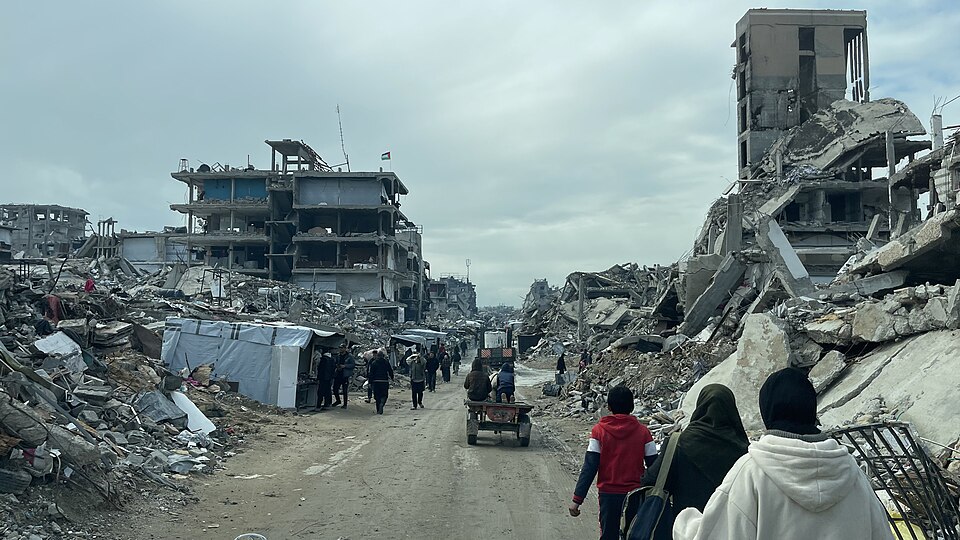
Today marks three years since October 7, 2023.For much of the world, October 7 has become an anniversary—a date revisited through headlines, political statements, and carefully packaged reflections. But for Palestinians, the October that began three years ago never truly ended.
It continued through every image we could not unsee. Every child pulled from beneath the rubble. Every mother calling out the names of her children. Every family forced to leave home with no safe place to go. Every hospital attacked, every neighborhood reduced to ruins, and every life spoken about as though it were only a number.
It continued every morning we reached for our phones, afraid of what we might find. Every time we whispered, “Ya Allah,” because there were no other words. Every time we held our own children closer after watching Palestinian parents endure the unthinkable.
Today, three years later, Gaza is still grieving. Palestinians are still being killed, displaced, starved, and denied the safety and dignity every human being deserves. The world may have grown accustomed to the images, but there is nothing normal about what Palestinians have been forced to endure.
For Palestinians, October never ended.
Our Story Did Not Begin on October 7

As we reflect on the past three years, we must also be clear: Palestinian history did not begin on October 7, 2023.
It did not begin when the world’s cameras turned toward Gaza. It did not begin when Palestine became a topic of debate on television screens or social media. Our story stretches back generations—through the Nakba, forced displacement, occupation, blockade, demolished homes, stolen land, separated families, checkpoints, imprisonment, and the continued denial of Palestinian freedom.
For decades, Palestinians have been asked to tell only fragments of that story. We have been expected to explain our grief without providing its history, to condemn without context, and to prove our humanity before anyone will acknowledge our pain.
But Palestinian lives did not become valuable only when the world started paying attention. And Palestinian suffering did not begin on a single day in October.
To remember Gaza honestly, we must remember the history that brought us here.
We Saw Our Own Children in Gaza’s Children

For Muslim mothers, watching the genocide in Gaza has carried a particular kind of pain.
We watched mothers cradle children the same ages as our own. We watched them try to calm frightened little ones while bombs fell around them. We watched parents search through rubble, write their children’s names on their bodies, divide small pieces of food among hungry mouths, and find ways to create comfort where no child could possibly feel safe.
We saw children asking questions no child should have to ask.
Will our house still be there?
Are Mama and Baba alive?
Will we have food today?
Are we going to die?
And as we tucked our own children into warm beds, packed their lunches, washed their clothes, or worried about the ordinary details of motherhood, we could not stop thinking about the mothers in Gaza who wanted nothing more than the privilege of an ordinary day.
Their children looked like our children. Their love sounded like our love. Their fear became the fear of every mother who watched.
There were moments when we turned away from our screens because the pain felt unbearable. Then came the guilt of being able to turn away at all.
The mothers of Gaza could not close the app. They could not silence the explosions. They could not take a break from the reality the rest of us were struggling to witness.
They were living it.
The Guilt of Continuing to Live

Over the past three years, many of us have struggled to reconcile our daily lives with what has been happening in Gaza.
How do we celebrate a birthday while another mother is mourning her child or a child their mother? How do we sit before a full table knowing families are searching for something—anything—to eat?
How do we plan vacations, shop for our homes, laugh with friends, or complain about the inconveniences of our day while an entire population is fighting to survive?
There is a quiet guilt that comes with continuing to live when so many lives have been taken.
But guilt alone will not help Gaza.
We are allowed to experience joy. We are allowed to care for our families, celebrate milestones, and thank Allah for the blessings in our lives. Our gratitude should not paralyze us; it should move us. It should make us more generous, more conscious, more willing to speak, and more determined not to treat the suffering of others as distant from our own.
The question is not whether we are allowed to keep living.
The question is what we will do with the life, safety, voice, and resources we have been given.
We Refuse to Become Desensitized

After three years, one of the greatest dangers is that Palestinian suffering becomes background noise.
A video appears between a recipe and an advertisement. We pause, feel devastated, perhaps share it, and then continue scrolling. Another death toll is announced. Another family is killed. Another child’s name is added to a list already too long to comprehend.
This is what constant exposure can do. It can overwhelm us until we become numb—not because we no longer care, but because caring continuously hurts.
We must resist that numbness.
Every number represents a person who was loved. A person with a name, a face, a family, a favorite food, a sense of humor, plans, memories, and dreams. Every destroyed home once held conversations, celebrations, arguments, bedtime routines, and meals shared around a table.
Palestinians are not content for us to consume. They are not symbols of suffering. They are human beings entitled to freedom, safety, dignity, and a future.
We cannot allow the length of this genocide to make it feel normal.
Our Prayers Still Matter—and So Do Our Actions

There may be moments when we wonder whether anything we do is enough.
We have made duaa. We have donated. We have protested. We have contacted elected officials. We have shared Palestinian stories, supported Palestinian businesses, and tried to educate the people around us. Still, the suffering continues.
It is easy to feel powerless.
But we should never underestimate the value of refusing to be silent. We should never believe our prayers are meaningless simply because we have not yet seen the answer we long for. Allah hears every duaa, including the ones made through tears when words will not come.
We must continue praying—and continue acting.
We can speak about Palestine even when it is no longer trending. We can teach our children Palestinian history in ways they can understand. We can support Palestinian journalists, writers, artists, organizations, and businesses. We can donate consistently, contact our representatives, challenge misinformation, and refuse to participate in the erasure of Palestinian voices.
None of us can carry everything alone. But each of us can carry something.
We Will Not Look Away
.jpg "October 7 Gaza genocide")
Today, on October 7, we are not simply remembering something that happened three years ago. We are acknowledging a genocide whose consequences Palestinians are still living every day.
We remember the people whose names we know and the many whose names we may never learn. We remember the families who should still be together. We remember the children whose futures were stolen and the parents forced to survive without them.
We also remember that Palestine is more than its suffering.
Palestine is faith, family, history, land, language, food, poetry, laughter, generosity, resistance, and love. It is mothers preserving family stories, children learning the names of their ancestral villages, and a people who continue to insist on living despite every effort to erase them.
For Palestinians, October never ended. It followed us into our homes, our conversations, our prayers, and the quiet moments when we held our children a little closer.
We will not remember Gaza only when another anniversary arrives.
We will continue to speak. We will continue to pray. We will continue to act. And we will continue to remind the world that Palestinian life is precious—not because Palestinians have suffered, but simply because they are human.
Gaza is not yesterday’s headline. The genocide is not a closed chapter. And our responsibility did not end when the world’s attention moved elsewhere.
May Allah protect the people of Gaza, comfort those who are grieving, heal the wounded, feed the hungry, shelter the displaced, accept the martyrs, free Palestine, and hold all those responsible for this genocide accountable.
Ameen.
